


Victorian rental law reform moved from “coming soon” to “here now” on 25 November 2025, and the flow-on effects will be felt throughout 2026.

Victorian rental law changes will make compliance records a rent roll asset. Here's what property managers need to know ahead of October 2026.
Millennials, migration and the ageing boom are shaping a major shift in Australia's housing preferences. Find out how this may affect your rent roll business.
As the year winds down, economists, forecasters and demographers are delivering their final takes on 2025 and predicting what’s likely ahead.
One of the most looked-to voices in this space, Bernard Salt, recently released his latest report on demographic trends, painting a detailed picture of how Australians will live, work and age over the next decade.
These shifts will impact (and are already impacting) the property market. Here are some insights for the rental property industry to take note of from Bernard’s presentation, which we were lucky to have access to.
The millennial generation, which once embraced compact city apartments and share houses, is entering a new life stage.
As more of them hit their late 30s and early 40s, they're opting for space, stability and lifestyle. Bernard Salt refers to this transition as the move from “apartmentia” to “forever homes”.
This is already visible in the data. Population growth between 2025 and 2035 is projected to be strongest in those within the classic homebuying years of 30 to 49. The winners from this will be lifestyle suburbs and regional towns within commuting distance of capital cities. Victoria’s Geelong is one of the places seeing some of the fastest growth in the country as part of this.
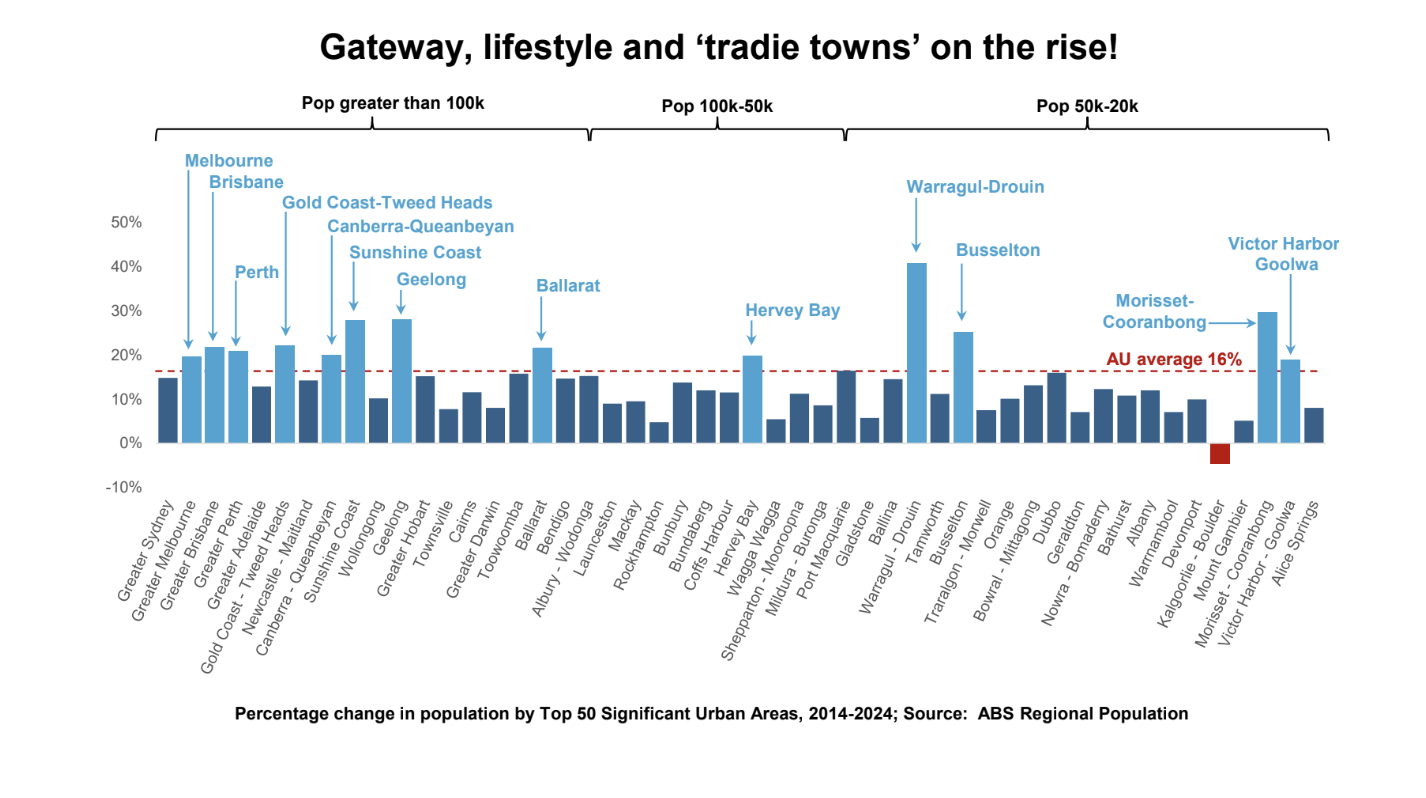
For property investors, the implications are clear: demand amongst millennials is shifting from dense inner-city rentals to spacious homes in lifestyle regions.
For rent roll owners, expanding to new areas is an option, in order to capture the millennial migration. Otherwise, it’s all about ensuring smaller apartments appeal to Gen Z.
The hybrid work revolution triggered by the pandemic was not a passing trend, even though some employers are pushing harder for a ‘back to the office’ approach. According to Salt’s analysis, about 15% of the Australian workforce is expected to work from home on an ongoing basis by 2026. Meanwhile, other research shows 47% of Australians work from home, at least some of the time.
This has had a flow-on effect on the types of homes people want. Floor plans have evolved to include home offices and spare bedrooms which can double as ‘Zoom rooms’. Meanwhile, gyms, battery storage, home veggie patches and EV chargers are more in demand.
Work, life and leisure now happen under one roof. For renters, this means more interest in houses with room to breathe rather than proximity to the CBD.
For rent roll businesses, this changes the game. Properties which once appealed only to families may now attract remote workers, pushing demand up in outer-metro and regional rental markets. Meanwhile, any property with a home office set up has instant renter appeal.
While long-term renting remains a reality for many Australians, there’s a noticeable tilt toward ownership among older millennials and younger Gen Xers. Homeownership is still seen as a rite of passage, even if it's delayed by a decade compared to previous generations.
At the same time, the diversity of Australia’s renting population is increasing. With immigration levels back on the rise and Australia’s migrant mix evolving (there are more arrivals from India, the Philippines and Nepal, and fewer from China) rental property expectations and needs are changing. New arrivals often rent first, but as they settle, they look for more family-focused and long-term options.
This opens opportunities for investors to build portfolios which reflect the needs of a broader cross-section of the community. This includes multi-generational housing, suburban family homes and properties in culturally diverse neighbourhoods.
There’s no denying the fact Australia is heading into a significant demographic shift. By 2032, the 85+ age group will grow by over 60,000 people per year, putting enormous pressure on the aged care services and housing options designed to support ageing in place.
In the private rental market, senior Baby Boomers could increase demand for single-level homes, accessible home features and quiet, community-focused locations. Older investors may also start to offload properties to fund retirement or aged care, potentially releasing more properties onto the market and giving investors expanded opportunities to buy.
From a rent roll perspective, this is worth keeping in mind. How could accommodating and supporting seniors bring potential for your business, and what will you do if older investors begin to liquidise their properties?
A recent report from Cotality suggested housing prices in capital cities could increase by 10% in 2026, so in the short term rent roll owners can expect healthy activity in the new year as investors enter and aim to take advantage of continuously positive conditions.
Meanwhile, Australia’s housing market is being pulled in new directions by the way we live, work and age. Being aware of trends is helpful in order to anticipate and prepare for changes in market demand.
From a rent roll perspective, the opportunities always lie in the places where people are motivated to live and the types of homes they want to live in. Shape your rent roll around both and you’ll be on track to expand in 2026 and beyond.
Start by mapping where millennial demand is heading in your part of the world, including lifestyle suburbs, growth corridors and commutable regional centres. If you’re open to expansion, consider partnering with local agencies in those hotspots or acquiring management rights in emerging areas. If you’re staying metro-focused, position smaller apartments to suit Gen Z by highlighting convenience, affordability and shared-living-friendly features (like flexible spaces, strong internet, and walkable amenities).
Renters are increasingly prioritising space and function over a CBD postcode. Homes with an extra bedroom, study nook or adaptable living area are more appealing because they support hybrid routines. Practical upgrades also lift demand: reliable NBN access, good natural light, acoustic separation between rooms, EV charging and outdoor space all add value. Even modest properties can compete well if they clearly offer a comfortable set-up for working and living under one roof.
Expect growth in demand for single-level homes, low-maintenance living and accessible features such as step-free entries, wider doorways and safer bathrooms. Location will matter too, as quieter neighbourhoods near health services, shops and public transport will be attractive. For investors and rent roll operators, this trend creates two opportunities at once: improving or acquiring senior-suitable stock, and staying alert to increased listings as older owners sell to fund retirement or care needs.
As minimum rental standards move from rollout to routine practice in Victoria, there is a flow-on effect for rent roll sales.
At BDH Solutions, we are noticing a red flag showing up in a number of transactions, where a non-compliant property is handed to a new rent roll manager as part of an exchange. This results in disputes during the retention period because the buyer can technically claim the property is worth nothing.
A single non-compliant property can trigger a dispute over value and responsibilities, and this costs everybody. Find out how to avoid the issue.
Rental property non-compliance and the problems it causes in a rent roll exchange
Victorian rules treat a non-compliant rental property as having no income value until rectified. As explained by Consumer Affairs Victoria, non-compliance might relate to factors such as smoke alarms, electrical safety, heating standards or locks. It can occur because a property owner has been reluctant to make upgrades, or the property manager has failed to take note of recent changes to legislation.
For a rent roll buyer, this creates uncertainty around cash flow and adds workload, since urgent checks, trades, and communication with renters are required to bring the dwelling up to a lease-ready standard.
For a seller, exchanging a rent roll with one or more non-compliant properties can mean a price reduction or removal of the property from the roll count used in the final adjustment.
The fine for non-compliance can extend to $59,000 and a listing on a non-compliance register for property managers and $11,000 for individuals. This is a hefty penalty and explains why compliance is such an important matter in a rent roll exchange.
The importance of due diligence ahead of a rent roll exchange
Due diligence should include lease reviews, certificates, maintenance logs and owner declarations, and responsibility falls to the seller and their property managers to confirm the necessary checklist is taken care of.
However, there are times when even best efforts result in issues being overlooked. A property manager may rely on verbal assurances, or records may be inaccurate. Because of this possibility, it’s best for both parties to plan ahead and agree on what to do if a non-compliant issue becomes evident during a transition period.
What to do about non-compliant properties during the retention period
If a non-compliant property is uncovered in retention, the stakeholders have two options.
1. Remove the property from the sale
A property with zero current income value can be excluded from the transaction. In practice, the buyer drops it from the rent roll count, the retention is adjusted, and the management agreement is ended or returned.
2. Keep the property under an agreed compliance plan
If both parties agree, the buyer may retain the property and follow a written plan to complete required works. Once standards are met, the property resumes at normal value within the portfolio. However, compensation will be required for the costs involved with ensuring the home complies with minimum rental standards.
Both options are workable, but problems arise when parties disagree about what to do and there is no clause in the contract.
When a non-compliant property becomes evident, the buyer may prefer removal to avoid risk and admin load, but the seller may push to keep the property in count, arguing compliance is close or the changes required are minor.
Without a pre-agreed rule, retention becomes a tug-of-war and can spill into legal action, which will have one guaranteed result: everyone spends money.
In this situation, prevention is the cure. Both parties should take the time to add a clause in the MoU or contract of sale confirming the course of action if non-compliance is found in retention.
The clause can say
the property is removed, with price and retention adjusted, or
the property stays if the owner signs a compliance plan within a set period, with costs allocated clearly.
Either route works. What matters is certainty before exchange. If both parties agree on the response to a non-compliant property, it won’t be a major issue.
A small clause now can save a major headache later. Let BDH Solutions work with you to prepare a pre-sale agreement covering every element so your exchange is trouble-free.
Non-Compliant Rent Roll Property FAQs
A property is non-compliant if it doesn’t meet any of the minimum standards which apply before a home is advertised or leased. These cover safety, security and basic amenity items such as working smoke alarms, electrical safety switches and compliant switchboards, secure locks on doors and windows, and safe, energy-efficient heating in the main living area. Since 1 July 2025, Victoria has also introduced additional energy-efficiency requirements (like insulation and draughtproofing), so compliance checks now need to include those upgrades too.
In practice, the seller carries the burden of confirming all managed properties are compliant at exchange, because the buyer is purchasing an income stream from lease-ready homes. This is why due diligence should include up-to-date certificates, maintenance logs and a completed minimum standards checklist for every property. Buyers should still verify high-risk items during due diligence, but solid reviews and documentation from the seller is what minimises retention disputes later.
If non-compliance shows up during retention, the safest path is to follow what the contract already says. Most transactions handle this one of two ways:
Remove the property from the sale, with the roll count, retention and price adjusted.
Keep the property under a written compliance plan, with clear timeframes and cost allocation so the buyer isn’t left funding urgent works for a non-compliant and unleasable property.
The approach should be agreed on upfront in the MoU or contract to avoid disputes during the retention period.Description text goes here
Download our guide to everything you need to know to prepare and sell your rent roll to get the best value.

