

For Victorian principals and property management executives looking at a franchised rent roll business, there are key differences between an independent rent roll business and a franchised rent roll business.
The two structures have differing risk and value profiles, and understanding the differences impacts everything from valuation criteria and due diligence to settlement timelines.
Valuation methodology
Essentially the value of the rent roll is the same regardless of the structure it sits in. What purchasers need to be mindful of is any franchise fees on property management income.
Independent rent rolls can have a cleaner multiplier, but that simplicity can be deceptive: staff retention, landlord relationships, and system transferability can be hidden costs of the transition because there's no franchise infrastructure to support the transition.
Qualitative comparison table:
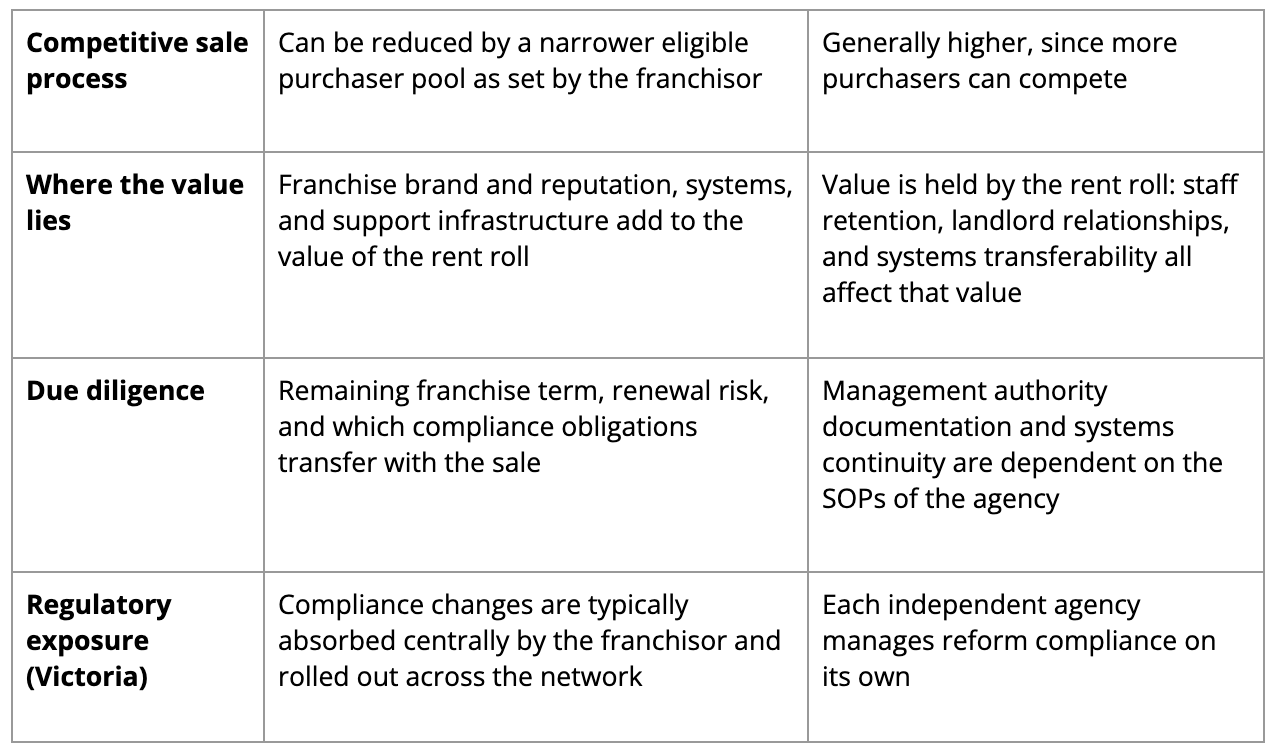
Key considerations for a franchise rent roll:
Purchaser
The purchase can be dependent on franchisor approval. Even with agreed terms and finance in place, the purchaser typically needs the franchisor to approve them as an incoming operator. This can add time, specific conditions, or in some cases rule them out entirely regardless of what the vendor may want.
The multiplier isn't the full cost. Ongoing royalties and marketing levies continue after settlement, so the purchaser needs to underwrite the transition on net returns after those obligations.
They're inheriting the remaining franchise term. Renewal timing, conditions attached to renewal, and any restraint or territory terms transfer with the sale. A purchaser buying into a franchise agreement with limited term remaining is taking on renewal risk as part of the price.
Vendor
The purchaser pool is constrained by the franchise criteria. Because the franchisor can restrict who qualifies to buy in, the vendor may have less competition in the sale process than an open-market sale would generate.
Transitions can be complex. A restraint of trade clause may limit where or how the vendor can operate afterwards, which matters if there's any possibility of re-entering the industry or working locally again.
Franchisor involvement impacts the process. The franchisor's approval rights, transfer conditions, and fee structure can influence timelines and deal terms in ways an independent sale doesn't.
Due diligence
The legislative reforms began in Victoria from 25 November 2025; minimum standards, the rental bidding ban, extended rent-increase notice periods, and no-fault eviction restrictions, standard application forms and application fee bans have all impacted the amount of due diligence required when looking at a rent roll transition regardless of whether it is an independent rent roll or a franchise.
For franchise rent rolls, due diligence needs to establish how much of the franchise agreement's term remains, renewal risk, and compliance obligations transfer with the sale. For independent rent rolls, the focus is on verifying the management authority documentation and SOPs are robust enough to withstand the same reforms without a franchisor's compliance framework behind them.
Speak to BDH Solutions for expert advice on independent and franchise rent roll purchases and sales.
-
Not necessarily. The multiplier is only part of the cost: ongoing royalty and marketing levy obligations continue after settlement, so a purchaser needs to weigh net returns after those obligations, not the multiplier in isolation, before comparing it against an independent rent roll's figure.
-
No. Because purchaser eligibility for a franchise rent roll sits with the franchisor's approval and veto rights under the franchise agreement, the vendor can't negotiate around a rejection the way they could in an open-market, independent sale. The decision authority sits outside the vendor and purchaser.
-
It depends on the structure. In a franchise rent roll, compliance changes are typically absorbed centrally by the franchisor and rolled out across the network, so an incoming purchaser inherits a framework already built around the reforms. In an independent rent roll, that responsibility sits entirely with the purchasing agency from day one.